

What Is a Toroidal Transformer Core?
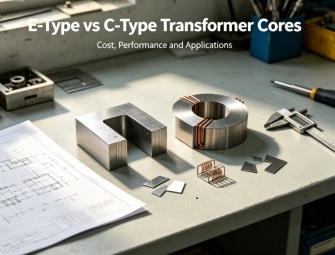
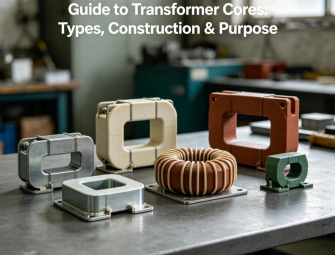
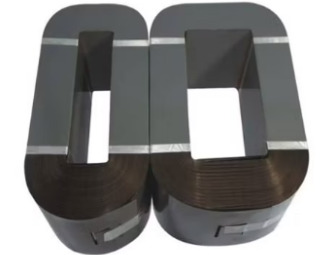
Toroidal transformer core is a kind of toroidal magnetic core with continuous closed-loop structure, and the core material is mostly silicon steel, ferrite or amorphous alloy. Unlike the traditional EI-type (rectangular) core, its magnetic circuit is closed and there is almost no air gap, which is a structural feature that makes its magnetic field more constrained and the flux leakage is extremely low.
In essence, toroidal transformer core is a ‘carrier’ for electromagnetic energy conversion, realising efficient transmission of electrical energy through the principle of electromagnetic induction. Its material selection directly affects the transformer’s frequency response, energy consumption level and operating stability. For example, silicon steel material is suitable for industrial frequency scenarios, while ferrite is more suitable for high frequency applications.
How Does a Toroidal Transformer Core Work?
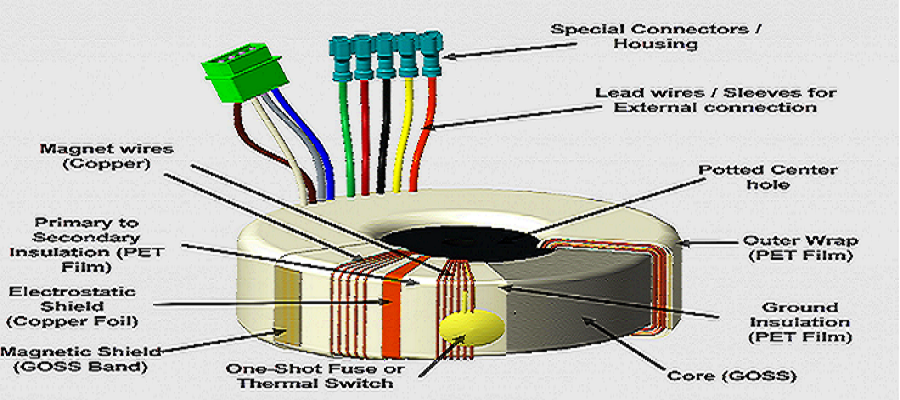
Work of toroidal transformer core is based on the basic physical laws of electromagnetic induction, the specific process is as follows:
Magnetic circuit construction: Toroidal closed-loop structure of the iron core provides a continuous and shortest transmission path for the magnetic flux, and when the primary winding (primary winding) is energised with alternating current, an alternating magnetic field will be generated inside the iron core.
Energy induction: Magnetic field is uniformly distributed in the closed iron core and passes through the secondary winding (secondary winding) wound on the iron core, and according to the law of electromagnetic induction, the secondary winding induces the corresponding electric potential and current;
High-efficiency transmission: As the iron core has no air gap and the magnetic circuit is short, the loss of magnetic flux is greatly reduced, and at the same time, the winding is more tightly wound and the resistance is smaller, which ultimately realises the high-efficiency conversion of electric energy from the primary side to the secondary side.
Core advantage of the toroidal structure over traditional iron cores is that there are ‘no breaks in the magnetic circuit’, which avoids wasted energy due to magnetic flux leakage, and this is the key reason why its efficiency far exceeds that of rectangular cores.
Key Advantages of Toroidal Transformer Cores
Ultra-high energy efficiency, low loss:
Closed-loop structure reduces the hysteresis loss and eddy current loss caused by the air gap, and the energy conversion efficiency usually reaches more than 95%, which is especially suitable for power-sensitive electronic equipment and long-term operation of the system.
Compact and space-saving:
Non-redundant structure design makes it 30%-50% of the size and weight of a traditional transformer, making it easy to be embedded in portable devices, automotive electronics and other space-critical scenarios.
Electromagnetic interference (EMI) is extremely low:
Closed magnetic field is almost completely constrained inside the iron core, the electromagnetic signals radiated externally are minimal, and will not interfere with the surrounding sensitive components, which is the ideal choice for medical equipment and communication systems.
Excellent heat dissipation performance, strong stability:
Continuous winding design allows the heat generated by the iron core can be quickly conducted to the outside, the working temperature is lower, effectively extend the service life of the transformer, reduce the risk of failure.
No audible noise:
Eliminates the vibration and ‘hum’ produced by the traditional iron core due to the magnetostrictive effect, suitable for audio equipment, recording studios, residences and other environments that require high levels of silence.
Common Applications of Toroidal Transformer Cores
Medical Equipment
Toroidal cores are used in MRI, defibrillators, monitors, etc., to meet the needs of low noise, precise voltage control, electrical isolation, to protect the detection accuracy and patient safety, low EMI, high stability to enhance the diagnostic accuracy, known as the ‘heart of the power’ of medical equipment.
Audio & Hi-Fi System
Used for amplifiers, professional speakers, Hi-Fi, etc., providing pure and interference-free power supply, eliminating noises, realising distortion-free power transmission and high-fidelity sound quality, standard for high-end audio equipment.
Industrial Automation
Used in industrial control panels, motor drives, robots, etc. Compact size saves space, excellent heat dissipation, resistance to harsh environments, and low failure to ensure continuous and efficient operation of the production line.
Communication and IT field
Used in server power supply, UPS, base station, switch, etc. Low EMI anti-data interference, electrical isolation to ensure safety, high reliability to support 24-hour uninterrupted communication.
Renewable Energy System
Suitable for photovoltaic inverters, wind power converters, energy storage devices, etc., with high conversion efficiency, low loss, weather-resistant and durable, long service life, suitable for long-term unattended outdoor operation.
Types of specialised transformers
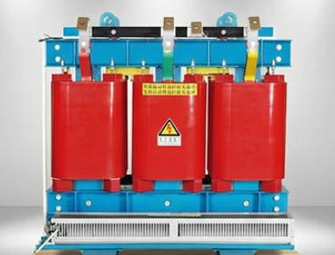
Power transformer: Lift the voltage to adapt to the equipment voltage;
Isolation transformer: Electrical isolation to prevent electric shock and protect the load;
Audio transformers: Impedance matching, optimising audio signals and sound quality.
How to Choose the Right Toroidal Transformer Core
When selecting a toroidal transformer core, the following 5 key factors should be considered in conjunction with the application scenario:
Frequency range and working period: Choose the appropriate core material (silicon steel for working frequency, ferrite for high frequency) according to the working frequency of the equipment (working frequency, medium frequency, high frequency), to ensure efficient operation under the target frequency.
Iron core loss: Give priority to low hysteresis loss and eddy current loss materials, balance the efficiency requirements and cost budget, long-term operation of the equipment is recommended to focus on low-loss characteristics.
Saturation flux density: according to the power requirements of the equipment to select the appropriate saturation flux density of the core, to avoid magnetic saturation resulting in decreased efficiency or equipment failure.
Cost-effective: Combined with the cost of materials, performance and supply stability, choose the best cost-effective solution, without blindly pursuing high-end materials, matching the actual needs.
Environmental compliance: Priority is given to materials that comply with RoHS and other environmental standards, avoiding the use of cores containing heavy metals and other hazardous substances, in line with the concept of green production.
Future Trends and Innovations
With the continuous development of power electronics technology, the future of toroidal transformer core will show three major trends:
Material innovation: Application of new materials such as nanocrystalline alloys and high-performance amorphous alloys will further improve the efficiency of the core, reduce losses, and at the same time reduce the size;
Intelligent integration: Combined with smart grid and Internet of Things technology, it realises real-time monitoring of transformer operation status and fault warning, and improves the intelligent level of power system;
Scenario expansion: Application in new energy vehicle charging, energy storage power station, 5G base station and other emerging fields will continue to expand, and become the core component of efficient power supply in these fields.
In the future, toroidal transformer cores will develop in the direction of ‘higher efficiency, smaller size, smarter and more environmentally friendly’, and continue to lead the innovation and upgrading of power components.
With its core advantages of high energy efficiency, compactness, low EMI, low noise and excellent heat dissipation, toroidal transformer core has become an indispensable power component in medical, audio, industrial, communication, new energy and other fields. Its closed-loop structure design fundamentally solves the many pain points of traditional transformers, providing a solid guarantee for the high-performance operation of modern electronic equipment and power systems.