

What Are Transformer Core Losses?
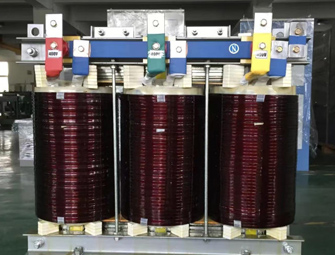
Transformer core loss (also known as iron loss), is the alternating magnetic flux in the core of the energy loss, even if the transformer no-load will continue to exist, and the size of the loss is proportional to the voltage, frequency, independent of the load.
Iron core loss is mainly composed of two parts:
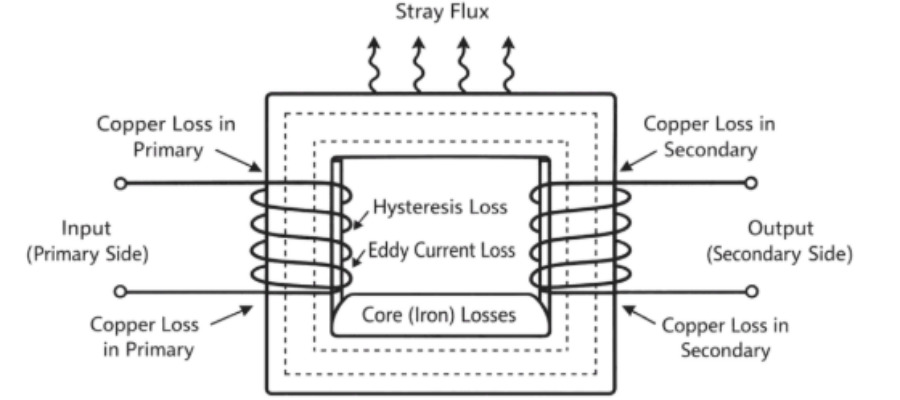
Hysteresis loss: Iron core material in the alternating magnetic field in repeated magnetization, magnetic domains turn to consume energy.
Eddy current loss: Alternating magnetic flux in the iron core steel induced ring current, resulting in Joule heat loss.
Excessive core loss will directly pull down the efficiency of the transformer, increase electricity expenditure, accelerate the aging of the equipment, long-term operation will also enhance the cooling and maintenance costs, is a power project must be optimized in the core indicators.
Use Advanced Low-Loss Core Materials
Core material is the core factor that determines the loss, and different materials have significant differences in hysteresis and eddy current loss, which are suitable for different application scenarios.
Silicon steel sheet
Silicon steel is currently the most commonly used core material for power distribution and power transformers. Adding 2%~4% silicon to iron can significantly increase resistivity and effectively reduce eddy current losses. Among them, oriented silicon steel further reduces the energy consumption of magnetic domain steering through the directional arrangement of grains, which is the optimal solution for 50/60Hz IF scenarios.
Standard silicon steel (30Q130) has a loss of approximately 1.30W/kg.
Loss of high grade silicon steel (23Q120) can be reduced to 0.90W/kg.
Applicable scenarios: distribution transformers up to 10kV, 35kV power transformers
Amorphous alloy materials
Amorphous alloy through rapid condensation to form a disordered atomic structure, greatly weakening the hysteresis effect, loss performance is far beyond the traditional silicon steel. 50Hz working conditions, its core loss is only 0.10W/kg, 60% ~ 70% lower than ordinary silicon steel.
Advantage: Very low no-load loss, long-term continuous operation with significant energy-saving effect.
Shortcomings: Brittle material, transportation and installation need to be protected.
Applicable scenarios: Power grid distribution transformers, new energy systems
Nanocrystalline materials
Nanocrystalline material consists of ultrafine grains of less than 100 nm embedded in an amorphous matrix, with high permeability and mechanical strength, extremely low coercivity, and almost no additional loss in magnetization demagnetization.
Advantage: Stable high-frequency performance, high saturation flux density, strong temperature adaptability.
Shortcomings: Complex production process, high cost
Applicable scenes: Charging pile, medical equipment, aerospace, high-frequency power supply
Ferrite material
Ferrite is a ceramic material with extremely high resistivity, almost completely eliminating eddy current losses, and is the exclusive choice for high frequency scenarios.
Strengths: Excellent energy efficiency at high frequencies
Shortcomings: Low saturation flux density, not suitable for high-power scenarios.
Applicable scenarios: Communication equipment, RF systems, switching power supplies
Optimize Core Design for Maximum Efficiency
High-quality materials with scientific design in order to minimize losses and improve the overall performance of the transformer.
Matching materials and working conditions
According to the operating frequency, power level selection of core materials, frequency with silicon steel / amorphous, high frequency with nanocrystalline / ferrite, to avoid additional losses caused by material mismatch.
Optimize core geometry
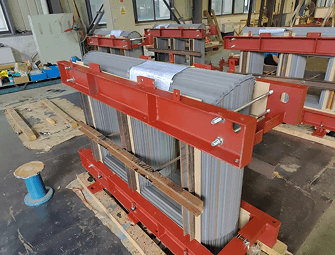
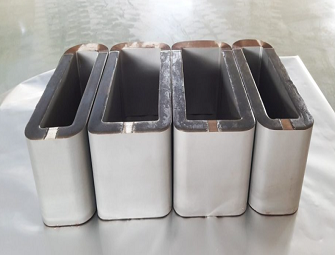
Adopt stacked iron core, stacked with thin steel sheets and coated with insulation layer to cut off the eddy current circuit and suppress eddy current loss from the structure. At the same time, the core size and shape are reasonably designed to control the magnetic flux density and avoid core saturation.
Standardized stacking and winding layout
Accurate stacking reduces the core air gap and reduces leakage loss; optimized winding arrangement reduces leakage inductance and resistance loss and improves energy transfer efficiency.
Enhanced cooling and insulation
Efficient heat dissipation (oil cooling / air cooling) to avoid high temperature aging of the core material and stabilize magnetic performance; reliable insulation to prevent electrical breakdown and ensure long-term safe operation, indirectly reducing fault loss.
Strict control of magnetic flux density
Magnetic flux density is controlled in a reasonable range to prevent the surge of loss caused by oversaturation and realize efficient energy transmission.
Apply Advanced Manufacturing Techniques
Design advantages require precision manufacturing, and process accuracy directly determines the actual level of iron core loss.
Strict control of manufacturing tolerances to avoid air gaps and magnetic leakage caused by dimensional deviations.
Ensure the stacking of steel sheets is aligned to reduce the resistance of magnetic circuit
Accurately position the windings and control the tension to reduce stray losses.
Full-process quality control to eliminate vibration, gaps and other hidden sources of loss.
Why Low-Loss Transformer Cores Deliver Higher ROI
Economic benefits
No-load losses are dramatically reduced, saving huge electricity costs in long-term operation
Initial investment premium can be quickly recovered through energy-saving gains, with a higher return on investment (ROI)
Lower temperature rise and slower aging of the equipment prolongs the service life and reduces maintenance and replacement costs
Environmental benefits
Reduced power waste and lower greenhouse gas emissions on the power generation side
Longer equipment life, reducing the environmental burden caused by scrapping and replacement
Reducing transformer core loss is the key to improving energy efficiency. Through advanced material selection, scientific design optimization and precision manufacturing, hysteresis and eddy current loss can be effectively reduced to achieve efficient operation. For power companies and other parties, low-loss iron core technology, although the short-term cost increase, but long-term energy-saving gains and reliability enhancement is significant, is the inevitable choice for the development of high-efficiency and low-carbon power system.