

What Are Core Losses in a Transformer?
Transformer in the process of power conversion, can not do 100% energy transfer, part of the electrical energy will be consumed in the form of heat in the iron core, this part of the loss is collectively referred to as the iron core loss.
Transformer efficiency is usually 95%-99%, but the loss will still significantly affect the long-term operating costs
Losses can lead to heat generation, insulation aging, shortened life and increased failure rates.
Reducing core losses is the core objective of electrical design, material selection and equipment manufacturing.
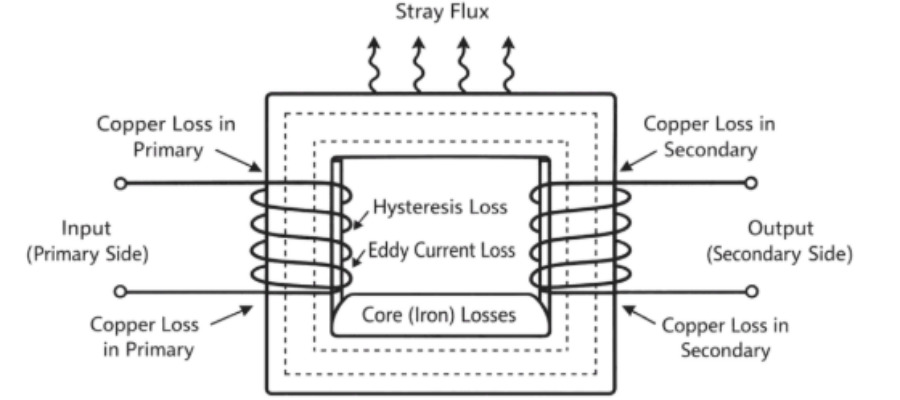
Iron core loss = hysteresis loss + eddy current loss, the two sources are completely different, and the control method is also different.
What Is Hysteresis Loss?
Basic Definition
Hysteresis loss is the energy loss caused by the friction of the magnetic domains of a ferromagnetic material (iron, silicon steel, nickel, etc.) when it is repeatedly magnetised and demagnetised in an alternating magnetic field.
Meaning of ‘hysteresis’ is that the magnetic induction lags behind the magnetic field strength, and the tiny magnetic domains inside the material consume energy and are converted into heat by internal friction when they are constantly turning in the direction of the magnetic field.
Causes
Direction of the alternating current is constantly changing, and the magnetic domains of the iron core must be rearranged repeatedly.
There is resistance to turning the magnetic domains and the energy is dissipated as heat.
Size of the loss depends on the hysteresis loop area of the material, frequency, magnetic flux density, and core volume.
Main influencing factors
Proportional to frequency
Proportional to the nth power of flux density (n≈1.5~2.5)
Strongly correlated with the magnetic properties of the core material
Affected by ambient temperature
Hazards to equipment
Heat generation in the iron core, accelerating the aging of insulation.
Reduce the efficiency of the equipment
Long-term high temperature shortens the overall life of the transformer
What Is Eddy Current Loss?
Basic definition
Eddy current loss is the I²R heat loss generated by an alternating magnetic field inducing a closed loop current (eddy current) inside a conductive iron core, with the current flowing through the core resistance.
According to Faraday’s Law of Electromagnetic Induction, a varying magnetic field induces an electromotive force inside a conductor, which in turn creates a closed current perpendicular to the magnetic field, i.e. an eddy current.
Causes
Magnetic field varies continuously with AC → a loop current is induced in the iron core.
Loop current flows inside the iron core → resistance heats up
It is a useless power consumption and is also classified as iron loss.
Main influencing factors
Proportional to the square of frequency (very sensitive to frequency)
Flux density is proportional to the square of the flux density
Core lamination thickness is proportional to the square of the core lamination thickness.
Inversely proportional to material resistivity
Hazards to equipment
Localised overheating, leading to excessive temperature rises in serious hot spots
Significantly reduce no-load efficiency
Increase heat dissipation pressure, increase operation and maintenance costs
Key Differences Between Hysteresis Loss and Eddy Current Loss
| Comparison Items
| Eddy current loss
| Hysteresis loss
|
| Root Cause | Magnetic field induces a closed loop current, I²R heat generation | Repeated steering of magnetic domains, internal friction generates heat |
| Physical nature | Electrical losses (Joule heat) | Magnetic loss (hysteresis loss)
|
| Frequency dependence
| proportional to f²
| Proportional to f |
| Thickness dependence | is proportional to t² | Almost independent |
| Main suppression methods
| Stacked structure, high hysteresis materials
| Low hysteresis materials (silicon steel, amorphous alloys)
|
| Occurrence conditions
| Conductor + Alternating Magnetic Field
| ferromagnetic material + alternating field
|
Importance of Reducing Core Losses
Enhance equipment efficiency
Lower the loss, the higher the efficiency, the lower the heat generation, the more stable operation and longer life.
Save long-term cost
Iron core loss is no-load continuous loss, high-efficiency equipment can save a lot of electricity costs every year.
Environmentally friendly and sustainable
Reduced power generation demand and carbon emissions, in line with global energy saving and dual-carbon goals.
Reduced operation and maintenance stress
Lower temperature rise, more durable insulation, fewer failures, and lower maintenance costs.
Modern Technologies Used to Minimize Core Losses
High permeability grain oriented silicon steel
Amorphous alloy core (ultra-low loss scenario)
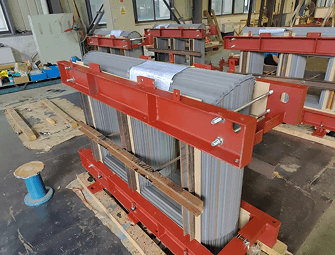
Stepped lap core structure to reduce local saturation
High-precision stacking, minimizing air gap
High-efficiency heat dissipation system, suppressing the rise in loss due to temperature rise
Hysteresis loss: Originated from the repeated flip of the magnetic domains of ferromagnetic materials, which is proportional to the frequency, and is reduced by high-quality conductive materials.
Eddy current loss: Originated from the magnetic field induction internal circulation, and the frequency is proportional to the square, by the laminated structure + high resistance materials to reduce.
Two together constitute the core loss, is the key to affect the efficiency of transformers, motors and other equipment. In the design, selection, manufacturing, while controlling hysteresis and eddy current losses, in order to truly realize the low-loss, high-efficiency, long-life high-performance electromagnetic equipment.