

What Is an E-Type Transformer Core?
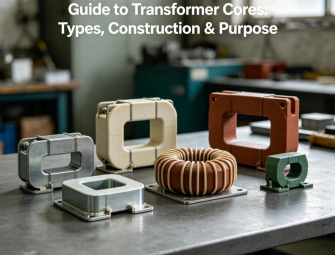
E-type core, also known as the EI laminated core, is the most widely used traditional core structure on the market. It is manufactured by die-stamping silicon steel sheets to produce standard E-shaped and I-shaped laminations, which are then assembled by stacking multiple layers in an interlaced pattern to form a complete, closed magnetic circuit. This core features a mature manufacturing process, a high degree of standardization, and low mass production costs, and its open structure provides excellent heat dissipation. Overall, it offers excellent value for money and is suitable for high-volume, general-purpose transformer products, finding widespread application in various consumer electronics and standard industrial control equipment.
What Is a C-Type Transformer Core?
C-type core is a high-performance wound core that eliminates the segmented stacking process used in E-type cores. It is formed by continuously winding a single piece of silicon steel strip, which is then high-temperature annealed, impregnated with varnish, and cured for reinforcement before being precision-cut into two symmetrical C-shaped components.
During assembly, the coil can be pre-installed; once aligned and clamped, it forms a complete magnetic circuit. This design ensures excellent magnetic circuit continuity, an extremely small air gap, low losses, and a compact, lightweight structure. This core is designed for high performance, low distortion, and low interference, and is specifically tailored for precision, miniaturized, and high-specification industrial and high-end electronic equipment.
How Are E-Type and C-Type Transformer Cores Constructed?
Type E Core: A mass-produced, general-purpose design formed by stacking stamped laminations. It features a simple, standardized manufacturing process, low cost, and stable supply. The structure incorporates multiple segmented air gaps, resulting in relatively high magnetic resistance and leakage flux; however, the open-laminated design provides excellent heat dissipation, making it suitable for high-volume, general-purpose transformer equipment.
C-type core: A high-performance, compact structure formed by winding a single continuous steel strip, featuring only a single precision-matched joint. It offers a complete and continuous magnetic path, minimal air gaps, low losses, high material utilization, and a lighter, more compact design. Its magnetic performance is superior to that of the E-type across the board, positioning it for high-end, precision transformer applications.
Primary difference between the two lies in the performance of the magnetic circuit air gap. The multiple seams in the E-type result in higher magnetic resistance and slightly greater interference; the C-type features a continuous and stable magnetic circuit, offering superior loss control and interference resistance. In terms of size, the E-type manufacturing process generates scrap and results in a bulkier overall design; the C-type offers higher power density, reducing volume and weight by 20% to 40% for the same power rating, making it better suited for miniaturized equipment.
Type vs C-Type Transformer Cores
Complete Performance Comparison Table
| Dimensions of Comparison
| Type E (EI laminated core)
| C-shaped wound core
| The stronger side
|
| Manufacturing Method
| Segmented Stamping + Stacked Assembly
| Continuous Steel Strip Coiling and Cutting (Separate Units)
| Choose E for mass production; choose C for high performance.
|
| Magnetic Air Gap
| Multiple seams; air gaps are too large
| A single precision joint with an extremely small air gap
| C-shaped core
|
| Iron-core losses, magnetic resistance
| The magnetic resistance is relatively high, resulting in greater no-load losses.
| Extremely low magnetic resistance, with minimal hysteresis and eddy current losses
| C-shaped core
|
| Heat dissipation capacity
| Open structure, large heat dissipation area
| Compact design with limited heat dissipation surface area
| E-shaped core
|
| Volume Weight
| Bulky and somewhat heavy
| Compact, lightweight, and high power density
| C-shaped core
|
| Leakage Inductance and Electromagnetic Interference
| High leakage flux; susceptible to interference from external magnetic fields
| Strong magnetic flux confinement results in lower EMI interference
| C-shaped core
|
| Production Costs
| The molds are versatile, and the unit price per batch is low.
| The production process is complex, requires a significant investment in equipment, and results in high unit costs.
| E-shaped core
|
| Winding Window Utilization
| Ample window space and flexible coil arrangement
| Can be pre-installed with a skeleton coil, offering good space utilization
| E-shaped cores hold a slight lead
|
| Operating Noise, Waveform Distortion
| Harmonic distortion is noticeable under medium-to-high loads
| Stable magnetic flux, extremely low waveform distortion, and low noise
| C-shaped core
|
Based on the multidimensional parameter comparison in the table above, it is clear to see the trade-offs and suitability advantages of E-type and C-type cores. Each difference stems from their distinctly different structures and manufacturing processes. In terms of manufacturing methods, E-type cores rely on stamped sections and stacked assembly—a simple, well-established process that is well-suited for high-volume mass production; C-type cores, on the other hand, are produced by winding continuous steel strips and then cutting them into separate sections. This process offers higher production precision and better magnetic circuit integrity, but comes with higher mass production barriers and costs.
Air gap in the magnetic circuit is the key factor behind the core performance differences between the two. The multi-piece assembly structure of E-type cores creates multiple seam gaps, resulting in relatively high overall magnetic resistance, higher no-load losses, and greater leakage flux. This makes the equipment more prone to electromagnetic interference and waveform harmonic distortion during operation; In contrast, C-type cores feature only a single precision-matched joint, with minimal air gap and excellent magnetic circuit continuity. This effectively reduces hysteresis and eddy current losses, significantly suppresses stray magnetic flux, and results in lower operating noise and a purer, more stable output waveform.
In terms of structure and heat dissipation, E-core’s open-stack design offers a large heat dissipation surface area and excellent natural cooling performance. It maintains stable temperature rise during prolonged full-load operation and does not require complex cooling designs; however, its overall volume is relatively large, and the unit is heavier. C-type cores feature a compact structure and high material utilization. At equivalent power levels, their volume and weight are far smaller than those of E-type cores, offering a distinct advantage in power density and making them better suited for miniaturized equipment. However, their compact structure results in limited heat dissipation surface area, requiring additional optimization of heat dissipation design under high-power operating conditions.
In terms of cost and practical suitability, E-type cores rely on standardized molds and mature mass-production processes, offering lower bulk purchase prices, ample stock availability, flexible coil layout, and high window utilization—making them the top choice for cost-sensitive general-purpose equipment; C-type cores involve complex manufacturing processes and require significant capital investment in equipment, resulting in higher overall production costs. However, they offer excellent electromagnetic compatibility and extremely low signal distortion, providing irreplaceable advantages in high-performance applications such as new energy, precision instruments, and high-end audio.
Which Transformer Applications Prefer E-Type Cores?
Thanks to their three key advantages—low cost, ease of mass production, and excellent heat dissipation—E-type cores are used in most consumer and general industrial products.
Consumer Electronics Power Supplies and Adapters
Power adapters for cell phones, laptops, and small household appliances typically use E-type cores. These products are shipped in large volumes, and mature stamping processes can significantly control material costs, fully meeting the basic daily requirements for transformer use.
Lighting Drivers and Ballasts
LED drivers and traditional fluorescent lamp ballasts commonly use E-type cores. Since lighting fixtures operate continuously for long periods under limited heat dissipation conditions, the open laminated structure provides excellent heat dissipation, preventing equipment damage caused by high temperatures.
General-Purpose Industrial Control Equipment
Standard models of industrial control equipment—such as machine tool control transformers and low-voltage isolation power supplies—all use E-type cores. A full range of off-the-shelf specifications is available on the market, making bulk procurement convenient for manufacturers and simplifying the sourcing of replacement parts for future maintenance.
Which Applications Prefer C-Type Cores?
C-type cores are characterized by low loss, low distortion, and compact size, and are primarily used in high-end, high-precision equipment.
High-End Professional Audio Equipment
Hi-Fi amplifiers, stage sound systems, and audio isolation transformers prioritize C-type cores. With extremely low magnetic flux distortion and minimal operational noise, they offer significantly improved sound reproduction compared to E-type cores, meeting the demands of professional audio applications.
Precision Medical Instruments
Biochemical analyzers and voltage-stabilizing power supplies for operating rooms utilize C-type cores. Medical instruments are highly sensitive to electromagnetic interference. C-type cores have minimal magnetic leakage, ensuring they do not interfere with internal precision components and guaranteeing accurate and stable test data.
New Energy Power Equipment
Photovoltaic inverters, energy storage converters, and UPS power supplies are suitable for C-type cores. Since these devices operate 24 hours a day without interruption, lower core losses can reduce overall energy consumption over the long term, aligning with the energy-saving requirements of the new energy industry.
How to Choose Between E-Type and C-Type Transformer
Identify Project Constraints
Compile all design specifications before selecting equipment to avoid rework later on.
Electrical Parameters: Rated power, input and output voltages, operating frequency, and continuous load duration.
Energy Efficiency Requirements: Whether compliance with Tier 1 energy efficiency standards, DOE, or IEC energy-saving regulations is required.
Physical Constraints: Maximum allowable overall dimensions, weight limit, and installation space dimensions.
Environmental Conditions: Long-term operating temperature, whether the unit is enclosed without forced air cooling, noise limits, and EMC certification requirements.
Production Requirements: Annual shipment volume, budgeted cost, lead time requirements, and whether standard off-the-shelf products are needed.
Match Core Types Based on Core Priorities
If the project’s core objectives are cost control, high-volume mass production, and heat dissipation, select an E-type core directly.
If the project’s core objectives are reducing size, minimizing losses, and controlling noise and waveform distortion, prioritize a C-type core.
When multiple requirements conflict, prioritize them as follows:
Cost > Size > Energy Efficiency → Type E;
Energy Efficiency > Size > Cost → Type C.
Evaluate Supply Chain and Production Compatibility
Advantages of Type E cores: Full range of stock sizes, short lead times, and assembly on standard production lines without the need for precision tooling or fixtures.
Suitable for high-volume consumer products in the millions, with ample after-sales replacement parts available.
Advantages of Type C cores: Flexible custom sizing, suitable for complex transformers with multiple windings; disadvantages include longer lead times, the need for specialized positioning fixtures during assembly, and relatively high unit costs for small batches.
Prototype Testing and Validation
After determining the core type, build a prototype to measure key performance indicators and verify that the selected design meets specifications.
Key test items: no-load loss, temperature rise curve, excitation current, output waveform distortion, overall unit noise, and electromagnetic radiation levels.
If the temperature rise exceeds standards or losses are too high, the thickness of the silicon steel material can be adjusted, or the core structure can be changed.
E-type and C-type transformer cores each have their own advantages and serve different purposes, making them suitable for different application scenarios. E-type cores offer outstanding cost-effectiveness, ease of mass production, and excellent heat dissipation, making them widely applicable in consumer and general industrial equipment such as home appliance power supplies, lighting drivers, and industrial control transformers. C-type cores, with their low losses, low distortion, compact size, and strong interference resistance, are better suited for high-end, high-performance applications such as professional audio, precision medical equipment, new energy power systems, and automotive and aviation systems.